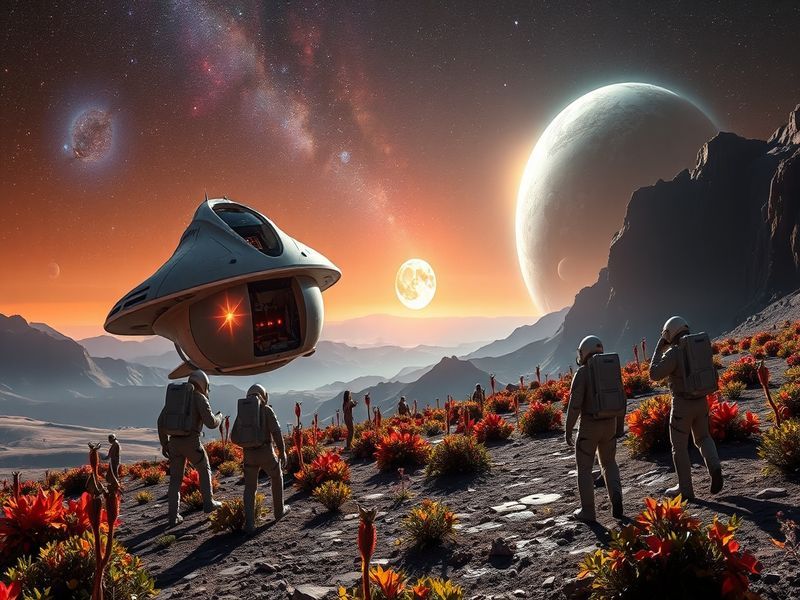
space exploration
Space Exploration: A Global Journey Beyond Earth
Humanity’s quest to explore the cosmos has evolved from ancient stargazing to cutting-edge robotic missions and ambitious crewed expeditions. This journey reflects not only scientific progress but also cultural, political, and economic ambitions that span continents. From the launch pads of Kazakhstan to the control rooms of Houston and the research labs of Tokyo, space exploration remains one of the most unifying yet competitive endeavors of our time.
Today, more nations than ever are investing in space technology, driven by the promise of discovery, national prestige, and commercial opportunity. The International Space Station (ISS), a symbol of global cooperation, orbits Earth every 90 minutes, hosting astronauts from over a dozen countries. Meanwhile, private companies like SpaceX and Blue Origin are reshaping access to space, turning what was once the domain of superpowers into a frontier open to innovation and enterprise.
The Historical Roots of Space Ambition
The dream of reaching the stars is ancient. Early civilizations mapped constellations for navigation and storytelling. The Chinese launched the first rockets in the 13th century, while European astronomers like Galileo redefined humanity’s place in the universe. But it was the 20th century that transformed dreams into reality.
The Space Race between the United States and the Soviet Union during the Cold War marked the beginning of modern space exploration. The launch of Sputnik 1 in 1957 stunned the world and sparked a technological marathon that culminated in the Apollo 11 moon landing in 1969. This era was not just about science—it was about ideology, power, and proving which system could reach the heavens first.
Yet even amid geopolitical rivalry, space became a venue for cooperation. The Apollo-Soyuz Test Project in 1975 demonstrated that even former adversaries could work together. Today, that spirit continues in programs like the ISS, where science transcends borders.
Nations Reaching for the Stars: A Global Perspective
Space exploration is no longer a two-country affair. A diverse coalition of nations is now shaping the future of space travel.
- China has rapidly become a leader in space, with its Tiangong space station, lunar probes like Chang’e, and plans for crewed missions to Mars. Its success reflects a long-term strategy backed by state investment and technological ambition.
- India, with its Chandrayaan lunar missions and Gaganyaan human spaceflight program, has positioned itself as a rising space power, emphasizing cost-effective innovation.
- Japan and Europe contribute cutting-edge technology: Japan’s Hayabusa2 asteroid mission returned samples to Earth, while the European Space Agency’s Rosetta probe made history by landing on a comet.
- UAE stunned the world with its Hope Mars mission in 2021, becoming the first Arab nation to reach Mars. It was a statement not just of scientific capability, but of national vision and regional inspiration.
- Private companies, especially in the U.S., are accelerating access. SpaceX’s reusable rockets have slashed launch costs, while companies like Axiom Space are building commercial modules for the ISS.
This global expansion is reshaping the narrative of space exploration. It is no longer just about prestige or science—it’s about economic opportunity, technological sovereignty, and even cultural identity. Countries like Nigeria, Turkey, and South Korea are investing in satellite networks and space agencies, recognizing that space infrastructure underpins modern life from GPS to communications.
Science, Sustainability, and the Search for Life
Beyond national pride, space exploration drives scientific breakthroughs that ripple across industries. Satellites monitor climate change, track deforestation, and predict natural disasters. The James Webb Space Telescope, launched in 2021, has peered deeper into the universe than ever before, revealing infant galaxies and potential signatures of habitable exoplanets.
One of the most compelling questions in space science is: Are we alone? Mars rovers like Perseverance are searching for signs of ancient microbial life in Jezero Crater. Europa Clipper, set to launch in 2024, will study Jupiter’s moon Europa, where a subsurface ocean may harbor life. These missions are not just about discovery—they’re about understanding our place in the cosmos.
Sustainability is also a growing concern. With thousands of satellites in orbit and plans for megaconstellations like Starlink, space debris threatens future missions. Agencies and companies are developing technologies to deorbit old satellites and clean up orbital clutter. International guidelines, though still evolving, are critical to preserving the space environment for generations to come.
The Future: Moon Bases, Mars Cities, and Beyond
The next decade will see humanity return to the Moon—not just for flags and footprints, but to stay. NASA’s Artemis program aims to land the first woman and the next man on the lunar surface by 2026, with plans for a sustainable base by the 2030s. China and Russia are collaborating on the International Lunar Research Station, a permanent outpost near the Moon’s south pole.
Mars remains the ultimate destination. Elon Musk’s SpaceX envisions a million-person city on Mars within decades. While ambitious, such a vision reflects a growing belief that humanity must become a multi-planetary species to survive long-term threats like climate change or asteroid impacts.
Beyond Mars, robotic missions are exploring the outer solar system. NASA’s Dragonfly mission will send a drone to Saturn’s moon Titan, where lakes of methane and complex organic chemistry could offer clues to life’s origins. Meanwhile, concepts like interstellar probes and laser-propelled lightsails are being studied to reach nearby stars within a human lifetime.
Yet with all this progress, ethical questions loom. Who owns the Moon’s resources? How do we prevent contamination between Earth and other worlds? What rights do future space settlers have? These debates are just beginning and will shape the legal and moral framework of space exploration for generations.
A Cultural Mirror: How Space Shapes Identity
Space exploration is more than a scientific endeavor—it’s a cultural force. It inspires art, literature, and film. From Stanley Kubrick’s 2001: A Space Odyssey to The Martian, cinema has shaped our collective imagination of what lies beyond Earth. Music, too, has been touched: David Bowie’s Space Oddity and Coldplay’s A Sky Full of Stars evoke both wonder and isolation.
In many countries, space success becomes a source of national pride. When India’s Chandrayaan-3 landed near the lunar south pole in 2023, millions celebrated in the streets. In Japan, Hayabusa2’s return with asteroid samples was a national event. These moments transcend politics; they unite generations under a shared sky.
Space also serves as a reminder of Earth’s fragility. Images of our blue planet from orbit have fueled environmental movements. The iconic “Blue Marble” photo from Apollo 17 in 1972 became a symbol of global unity and ecological awareness. Today, astronauts regularly share images of Earth’s beauty—and its vulnerability—on social media, reaching millions with a message of stewardship.
Conclusion: A Shared Journey into the Unknown
Space exploration is humanity’s most ambitious collaborative project. It demands not only technological mastery but also patience, cooperation, and vision. As nations and companies push the boundaries of what’s possible, they remind us that the final frontier is not just a destination—it’s a shared human story.
From ancient observatories to Mars rovers, from Cold War rivalries to international partnerships, our journey into space reflects our best and sometimes our most challenging impulses. But it also offers hope: that despite our differences, we can look upward together, dream big, and build a future among the stars.
As we stand on the brink of a new era—one that includes lunar bases, Mars colonies, and perhaps first contact with extraterrestrial life—one thing is clear: the universe is not just waiting to be explored. It is calling us to rise.